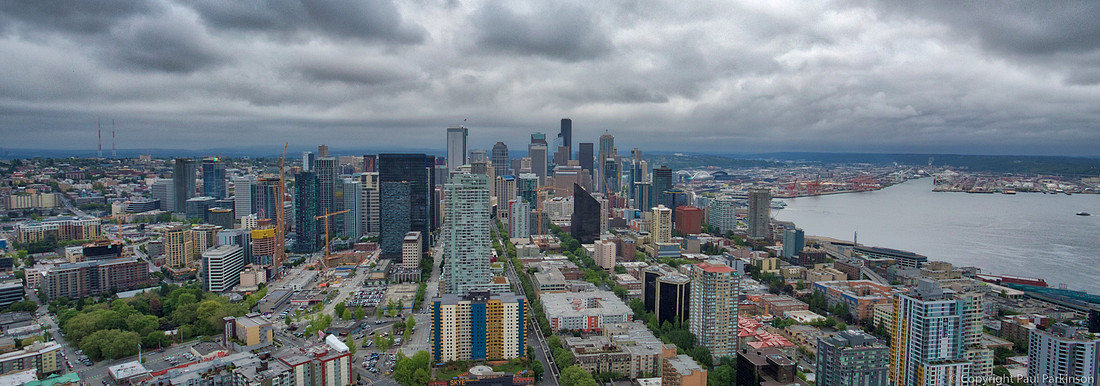
 Seattle and Elliott Bay from the Space NeedleCanon EOS 5D Mark III, 17mm, multiple exposures @ f/22, processed in AuroraHDR 2018 (realistic filter)
In late May, I had the opportunity to visit Seattle for a few days for some sightseeing. It turned out that the weather during my visit was mostly sunny, and some of the locals said I was fortunate to miss a lot of Seattle rain!
During the visit I had the opportunity to visit Seattle's famous landmark, the Space Needle, and try to capture some shots of the Seattle skyline and Elliott Bay from the viewing platform. The Canon EOS 5D Mark III is capable of performing in-camera high dynamic range (HDR) processing of bracketed images. This is a convenient feature, but the downside is that the output HDR image is saved in JPEG format, which means that there's less scope for post-processing if you're not entirely happy with the results.
I've been a long time user of Apple's excellent Aperture photo-processing and management application on my Mac, and I was very disappointed at Apple's decision to discontinue Aperture in favour of the Photos application. After some experimentation, I decided I would not be migrating to Apple Photos, and I decided to use Adobe Lightroom as my default photography application instead. Lightroom is even more capable than Aperture in many respects (but not all - e.g. face recognition), but the workflow isn't quite as user-friendly as Aperture. I have also recently upgraded from Adobe Lightroom 5.6 to 6.0, and one of the new features included in the updated version is HDR processing, which I've experimented with a bit.
However, I decided it was worth trying out a dedicated HDR processing application, and after reading positive reviews of AuroraHDR 2018, I've taken the plunge and purchased it. Although I haven't had the opportunity to spend a lot time with it yet, my experiences have been positive so far. It installs cleanly and integrates well with Lightroom 6.0, which means that I can export photo RAW files from Lightroom to AuroraHDR, perform HDR processing and then send the results back to Lightroom, enabling them to be managed by the Lightroom catalogue. This is a very nice workflow.
HDR photography can polarise opinion, with some people being fans of the saturated images, and others take an instant dislike to them. My own personal preference is for "realistic HDR" images, which enhance the detail and colour of a scene, but without looking over-processed and unrealistic. I've added some photos to the Seattle gallery (and also Hawaii gallery) which illustrate some of the HDR processing modes available, and will add some photos from my whale watching trip in the Puget Sound, which was very memorable!
]]>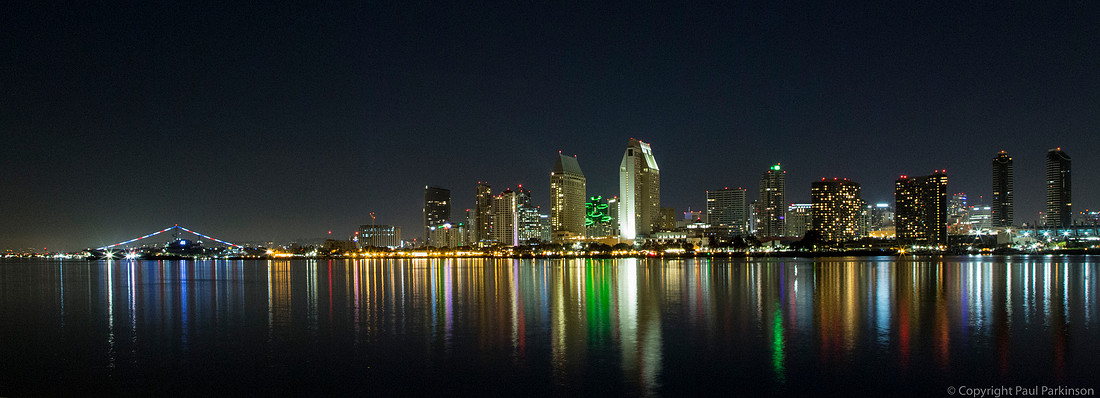 San Diego at night from CoronadoCanon EOS 5D Mark III, 28mm, 5.0s @ f/18, ISO 3200
It's been ages since my previous blog, as although I had arranged a trip to Chamonix in the French Alps in summer 2016, I had to cancel it at short notice. However, I've just returned from an extended trip to San Diego where I had the opportunity to do some sightseeing, and indulge my passion of urban and night-time photography!
I was motivated to try to get a shot of the San Diego skyline across the bay from Coronado, as one of the screen backgrounds on my MacBook Retina Pro is San Diego from Coronado at night. Although the weather in San Diego in late January was unusually stormy, I did manage to capture the city skyline late one evening when it was dry.
I took all my Canon L-series lenses to San Diego (17-40mm f4 L, 24-105mm f4 L and 70-200m f4 L), and had been expecting to use the 17-40mm wide-angle lens with my Canon EOS 5D Mark III for the city skyline panorama shot, as this lens had been really useful during a trip to San Francisco. However, because of the distance of the Coronado east shore from San Diego, I found that the 24-105mm f4 L proved to be the most useful. I took the above photo at 28mm zoom with f/18 aperture to produce the starburst effect from point light sources, and 5 second exposure using a tripod.
I've created a San Diego gallery, and will add more photos in the coming days...enjoy!
]]>
I've just returned from another trip to Zermatt in the Valais Alps in Switzerland, where I had the opportunity to combine my passions of hiking and photography again.
Last year, I managed to capture the sunrise on the Matterhorn from Riffelsee below the summit of Gornergrat, and this year I was hoping to repeat the experience, but from the summit of Rothorn (3,103m), which is further away and would provide the more familiar north-east view of the Matterhorn and the opportunity to capture other peaks such as Klein Matterhorn, Breithorn et al. when using a wide-angle lens.
I had taken this sunrise photo from Rothorn in 2007 using a Canon S60 Powershot compact digital camera, but as this only had a 5MP sensor, and I wanted to shoot the scene again using my full-frame Canon 5D Mark III with a Canon 17-40mm f4L wide-angle lens.
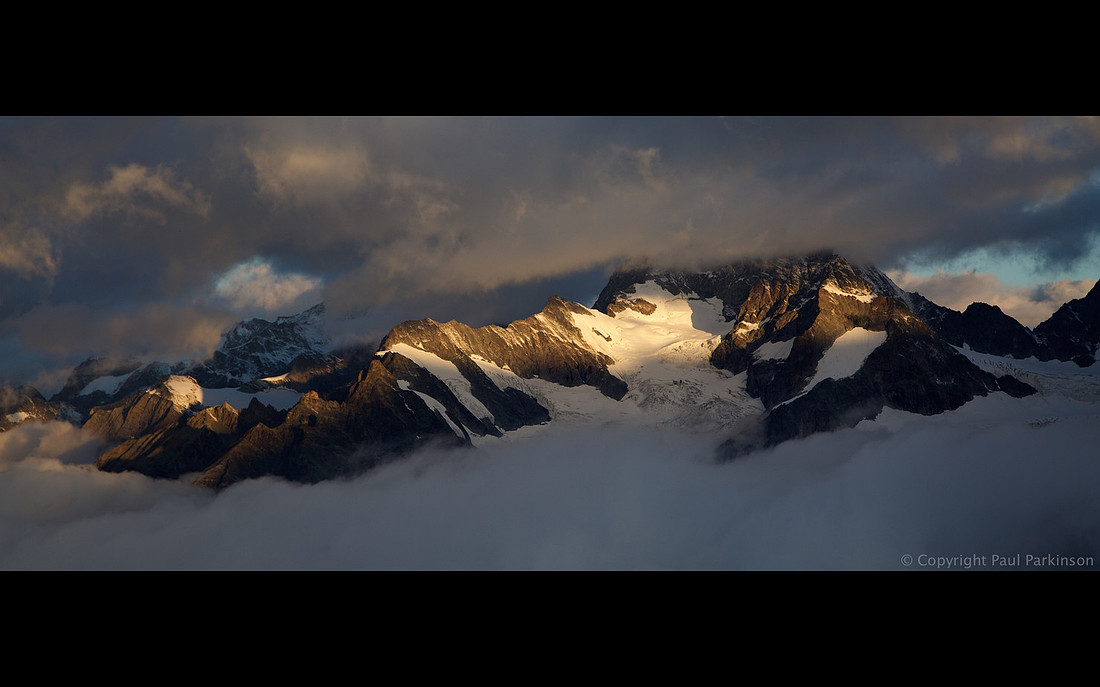
However, it was only when I reached the the summit of Rothorn just before 6am, I found that it wasn't to be, as the unsettled weather had left quite a lot of cloud cover on the Matterhorn and the surrounding peaks. However, this did provide the opportunity to take some moody shots of Zinalrothorn, Ober Gabelhorn in cloud (above), with the transient light providing some nice effects on the snow and rock, and also this shot of Weisshorn.
This summer is also the 150th anniversary of the first ascent of the Matterhorn led by Edward Whymper on 14th July 1865. One of the ways which this was commemorated was by the illumination of the route of the first ascent each evening at 9.15pm. I took a telephoto shot of the Matterhorn and a wide angle shot including Zermatt from the balcony of my hotel using a tripod and long exposures.
I hope to upload more photos of my latest Zermatt trip to the Swiss Alps gallery in the coming days when I can find some spare time!
]]>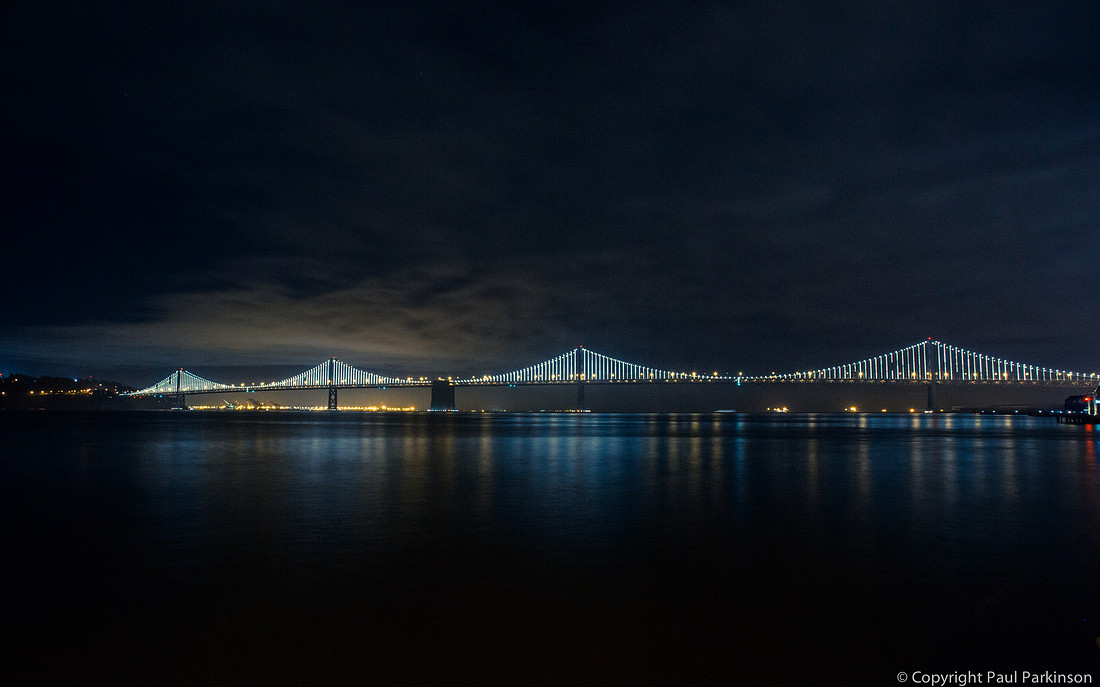 San Francisco Bay Bridge from Pier 5 (2015)Canon EOS 5D Mark III, f/18 @ 17 mm, 20s, ISO 3200, processed with Adobe Lightroom Cold tone filter
I've just got back from a business trip to San Francisco, and although I knew that the schedule would be very hectic, I decided to take my Canon 5D Mark III just in case I'd have an opportunity to take some photos of the city skyline.
On the evening that I arrived, as the weather was dry, I dashed down to the harbour to take some photos of the recently renovated Bay Bridge and the city skyline from Piers 1 & 5. You can compare the images that in the San Francisco gallery that I took with the 5D Mark III with some that I took with my Canon EOS 450D back in 2011.
I am slight disappointed that the sky looks a bit grainy in some of the night time shots at due to sensor noise at 3200 ISO, but this was my fault for not locking the shot to ISO 400 or 800 (probably due to being third having been awake for 24 hours!). However, I do like the results of shots of the Bay Bridge when processed with Adobe Lightroom's Aged Photo Filter and Cold Tone Filter.
I took most of these shots with a Canon 17-40mm f4 L IS wide angle lens, which provides a noticeably broader field of view than the general purpose 24-105mm f4L IS lens which I use most of the time.
]]>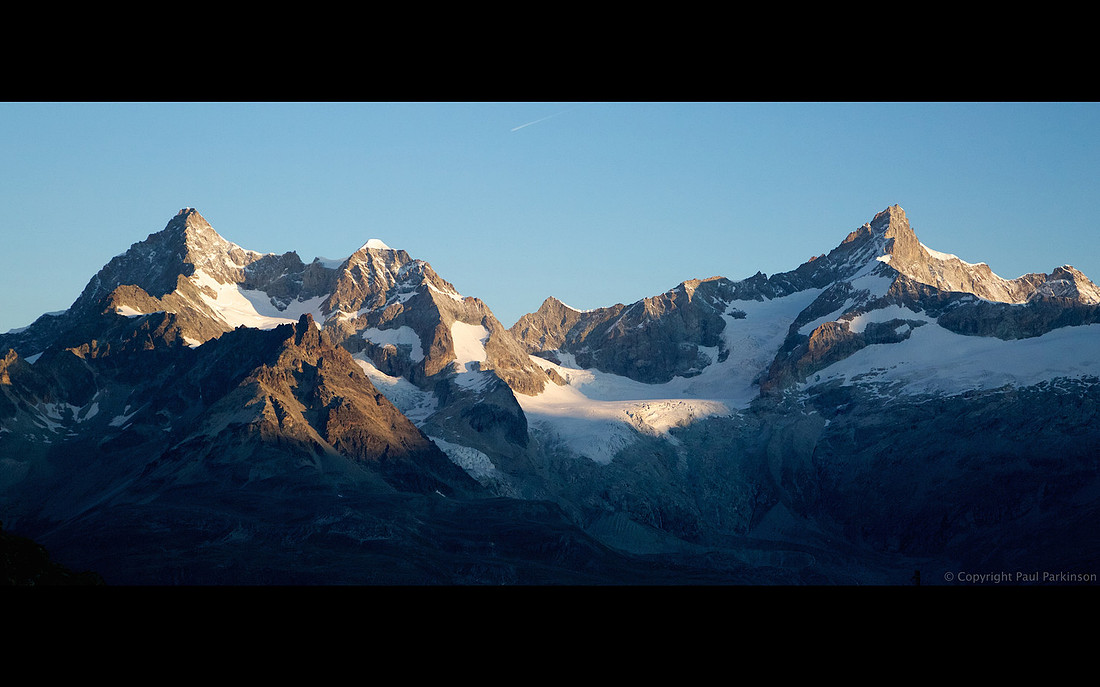 Sunrise on Ober Gabelhorn (4,063m), Wellenkuppe (3,093m) and Zinalrothon (4,221m) from Gornergrat (3089m)Canon EOS 5D Mark III, f/8 @ 73 mm, 1/80s, ISO 1250
I've just returned from a summer holiday in Zermatt, Switzerland, where I spent some time hiking in the fabulous Valais Alps. As well as enjoying the stunning scenery, I also had the opportunity to try out my Canon EOS 5D Mark III on landscape photography in a range of different lighting conditions.
For the trip, I took my Canon 5D Mk III, 24-105mm f4/L IS lens, and 70-200mm f4/L lens. I use a fixed UV filter with the 70-200 lens, but for the 24-105 lens, I had the opportunity to borrow a Heliopan variable gray 0.3-1.8 neutral density (ND) filter. This provides a reduction of 1 to 6 stops, which is very useful in the extreme lighting conditions in the Alps where there is intense glare from UV light reflected off the snowfields and glaciers. This enabled me to use longer exposures without suffering from saturated over exposure of snow fields. I found a few minor drawbacks using the Heliopan filter: at widest lens angles the filter produced some vignetting of images which I needed to manually correct in Aperture or Lightroom; also, the filter cannot be with the Canon 24-105mm lens cap or lens hood, which is a bit inconvenient.
I also experimented with the 5D's in-camera HDR (high-dynamic range) processing - taking three photos of the same scene at different exposure levels, and then combining them into a single image. The result extracts more detail from a scene, but perhaps looks slightly over saturated?
I've uploaded some of the photos of the holiday to the Swiss Alps gallery (which also includes some photos which I took in 2010 using my Canon EOS 450D). I found some of the results quite pleasing, in particular the Sunrise over Ober Gabelthorn, Wellenkuppe and Zinalrothon and Sunrise on Matterhorn. Hope you enjoy them!
]]>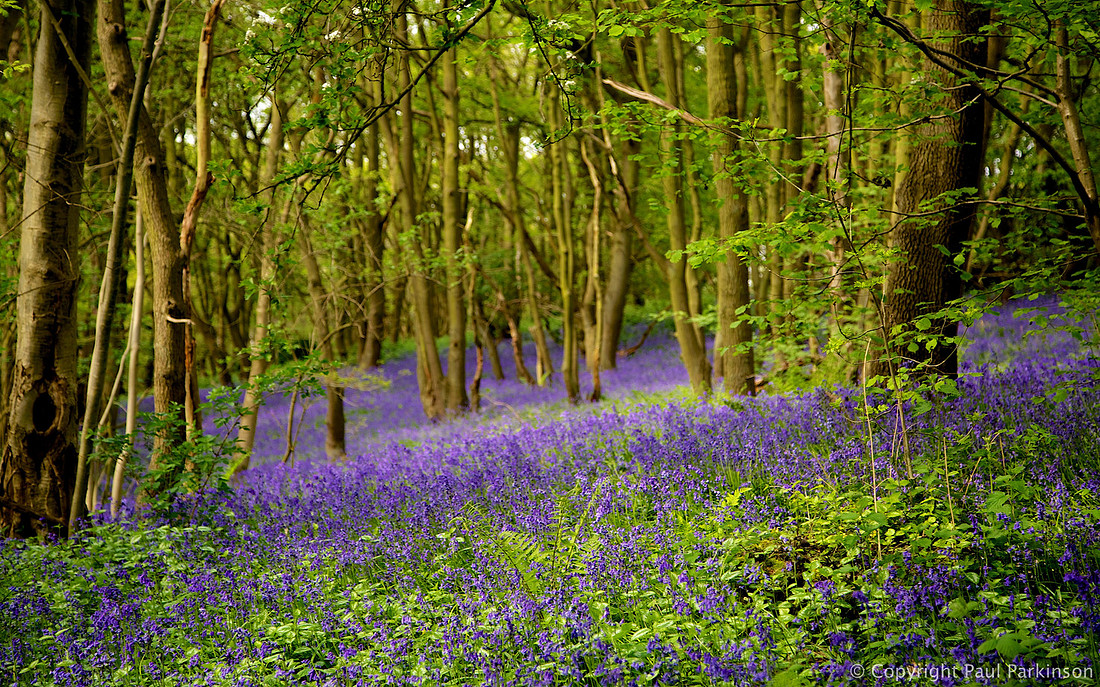 English woodlands with bluebells in MayCanon EOS 5D Mark III, f/4 @ 75 mm, 1/80s, ISO 160
I've not been able to spend as much time as I would have liked getting familiar with my new Canon 5D Mark III over the last few months, due to work and other commitments, and most of the time I have spent using it has been at events and also with family. I've been very impressed with the 5D3's sophisticated autofocus system, it's capable of capturing moving subjects in crisp freeze-frame.
However, I did manage to get out into the local woodlands for some landscape photography one Sunday afternoon in May, and managed to capture the bluebells in bloom. I was hoping to get a shot of sunlight breaking through the tree canopy, leaving sunbeams on the bluebell carpet below, but alas as the sky was overcast, the ambient lighting turned out to be rather uniform. However, I did manage to get a nice shot of my supermodel, my retired greyhound.
I also managed to capture a few shots while up in the Scottish Highlands for a short break in June, but I'm really looking forward to my next trip to the Swiss Alps later in the summer. In the meantime, I'm trying to pick up some tips on how to get the best out of the 5D3 from Charlotte Lowrie's 'Canon EOS 5D Mark 3 Digital Field Guide'.
]]>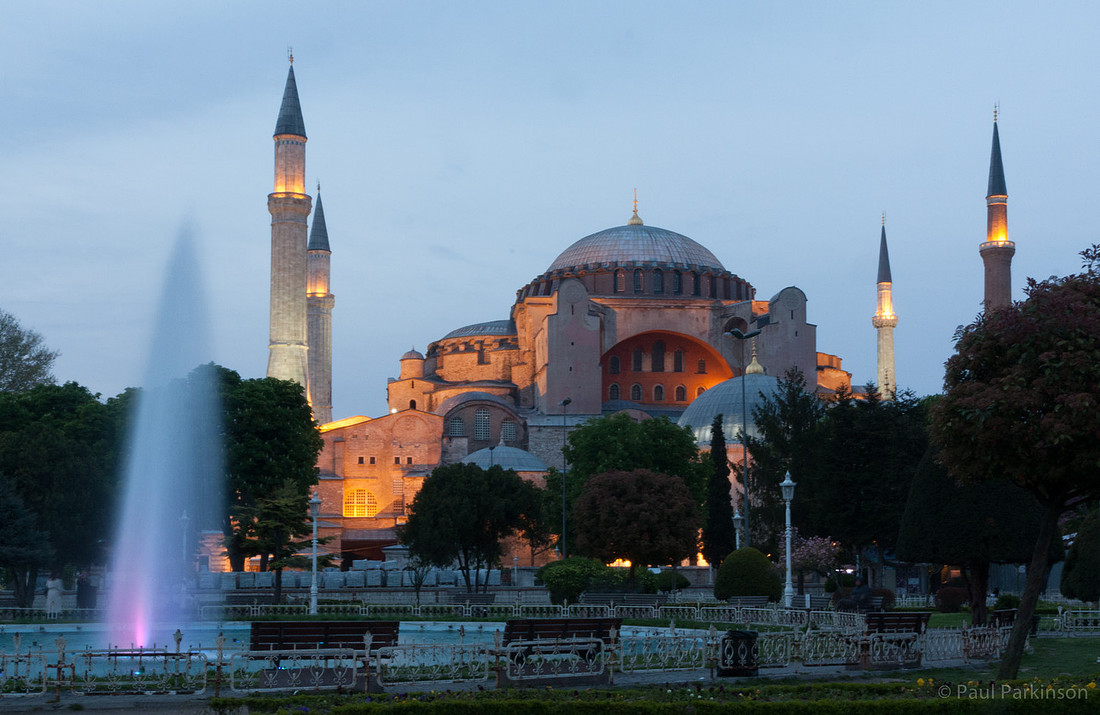 Hagia Sophia Canon EOS 450D, f/22 @ 28 mm, 2s, ISO 800
I visited Istanbul on a business trip in 2011, and was fortunate to have the opportunity to take some photos of the city's fabulous architecture (although some of my colleagues got a bit annoyed waiting for me while I was running around with my digital SLR and tripod!).
I haven't posted the photos online before now, as some of the photos that I had taken of the mosques' minarets (with my Canon EOS 450D and EF-S 15-85mm lens) had suffered from noticeable barrel distortion in wide angle shots (and I am a bit of a perfectionist).
However, this week I acquired a (genuine) copy of Adobe Lightroom 5 (as part of a camera upgrade package), and this includes the capability to correct barrel distortion and vignetting or individual camera lenses (which Aperture doesn't provide by default). Lightroom seems to be quite effective at correcting the distortion (but it is more complicated than Aperture to use). Anyway, I hope you enjoy the results.
In my next blog post, I hope to post some results of my new Canon 5D Mark III. In the meantime, I need to read through the 400 page manual!
]]> Stormy sunset over Hanalei Bay, KauaiCanon EOS 450D, f/5 @ 40 mm, 1/160s, ISO 200
Last year, I was very fortunate to have the opportunity to spend two weeks on the stunning Hawaiian island of Kauai, which is known as 'The Garden Isle' because to its stunning lush scenery (due to the high tropical rainfall).
I've selected some of my favourite photos from the trip for the Hawaii gallery, including the breathtaking ancient Nā Pali coastline and Waimea Canyon. I also loved the wildlife, sea turtles, spinner dolphins and humpback whales! I hope to add some more photos soon.
]]> Dublin and River Liffey from O'Connell BridgeCanon EOS 450D, f/4 @ 20 mm, 0.4s, ISO 800
I was in Dublin, Ireland, earlier this week for a conference, and although there as wasn't much free time for sightseeing as I would have liked, I took the opportunity to dash out one evening between the showers with my Canon EOS 450D digital SLR and my tripod. I managed to capture a few nighttime shots of the city before my hands got too cold!
I took the photo above of the River Liffey and Dublin skyline from the O'Connell Bridge in Dublin city centre. I've posted some of the other shots in the Dublin gallery. I've only performed basic processing of the RAW images in Aperture (Exposure, Contrast, and Cross-Process 1 filter or Black & White filters in some cases), but I think the end results are quite pleasing.
As you'll see from some of my other galleries, I enjoy taking urban night time photos, especially riverside scenes as I think the reflections of the city lights in the water help to capture some of the atmosphere of a place.
]]>